Two questions come up regularly from Tolleson homeowners dealing with hard water: whether to install a water softener, and whether to install a reverse osmosis system. Many homeowners assume these are alternatives to each other, or that one replaces the need for the other. They are not alternatives. A water softener and a reverse osmosis system serve entirely different purposes, protect different parts of the home, and work best when used together. Understanding what each one does, and what each one cannot do, is the starting point for making a practical decision.
The Hard Water Problem in Tolleson
Tolleson's water supply runs 16 to 19 grains per gallon of mineral hardness, well into the very hard classification. At that level, calcium and magnesium scale accumulates continuously on every pipe interior, every water heater heating element, every fixture, and every appliance that water contacts. Water heaters fail in 6 to 8 years rather than 11-plus in soft-water markets. Drain pipes accumulate scale that narrows flow diameter over time. Aerators and showerheads block on compressed schedules. Any treatment strategy for a Tolleson home needs to account for both the infrastructure protection problem and, separately, the drinking water quality objective.
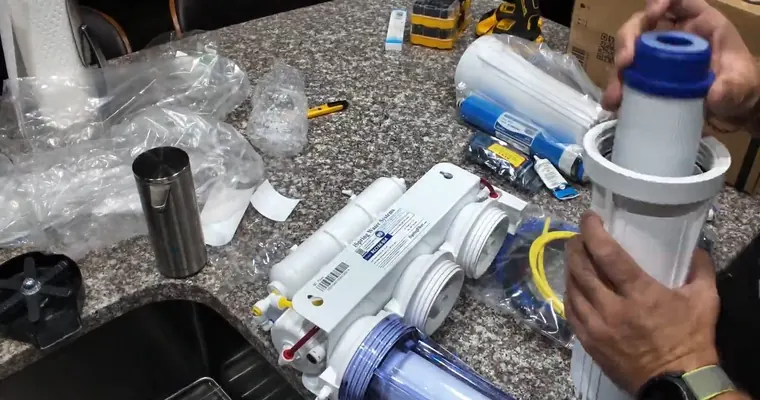
Under-sink RO systems treat drinking water separately from whole-home hardness control. It fits the Water Softener vs Reverse Osmosis in Tolleson, AZ: Which... section. The repair area is visible from a closer angle.
What a Water Softener Does
A water softener uses ion exchange to remove calcium and magnesium from the water as it enters the home. Hard water passes through a resin tank where calcium and magnesium ions trade places with sodium ions on the resin beads. The softened water leaving the tank carries no calcium or magnesium, so it deposits no scale anywhere in the home.
A water softener treats every gallon of water entering the house: supply lines, water heater, dishwasher, washing machine, all fixtures, all appliances. It is whole-home infrastructure protection. A softener does not remove chlorine, chloramine, or other dissolved substances from the water. It adds a small amount of sodium to the treated water. It cannot produce the drinking water quality that an RO system provides.
What a Reverse Osmosis System Does
A reverse osmosis system forces water through a semi-permeable membrane at a single tap, typically the kitchen sink. The membrane removes nearly all dissolved solids: calcium, magnesium, sodium (including sodium introduced by a water softener), chlorine, chloramine, lead, nitrates, and most other dissolved compounds. The result is water very close to pure H2O at the filtered tap, with total dissolved solids typically below 50 mg/L compared to Tolleson's supply water which may run 400 mg/L or more.
A reverse osmosis system treats only the water at the specific tap where it is installed. It does not protect the whole-home plumbing system or any appliances from scale. It is not designed for whole-home supply flow rates.
Why They Work Together
The key insight is that each system protects something the other cannot.
- The water softener protects the house: supply lines, water heater, washing machine, dishwasher, and every fixture and appliance from ongoing scale damage
- The RO system protects drinking and cooking water quality: it removes virtually all dissolved solids, including the sodium the softener introduces, producing water close to pure at the kitchen tap
For most Tolleson homeowners, the combination of a whole-home water softener paired with an under-sink RO system at the kitchen tap is the most complete response to both problems simultaneously.
If You Can Only Do One
If budget requires prioritizing, the water softener typically provides a larger financial return by protecting against the accelerated plumbing and appliance deterioration that Tolleson's hardness level drives. A water heater failing in year 7 instead of year 12 is a substantial cost. Recurring drain cleaning for scale-driven blockages adds up over time. The RO system addresses drinking water quality specifically, which can be managed in the interim with a pitcher filter or bottled water while the softener's infrastructure protection benefits accumulate. The two systems are best combined but the softener addresses the larger financial risk first.
Further Reading
Our Water Softener Installation page covers sizing, the ion exchange process, and what the installation involves at a Tolleson home. Our Water Filtration and Reverse Osmosis page covers under-sink RO system installation, whole-home carbon filtration options, and maintenance requirements for RO membranes in Tolleson's hard-water conditions.