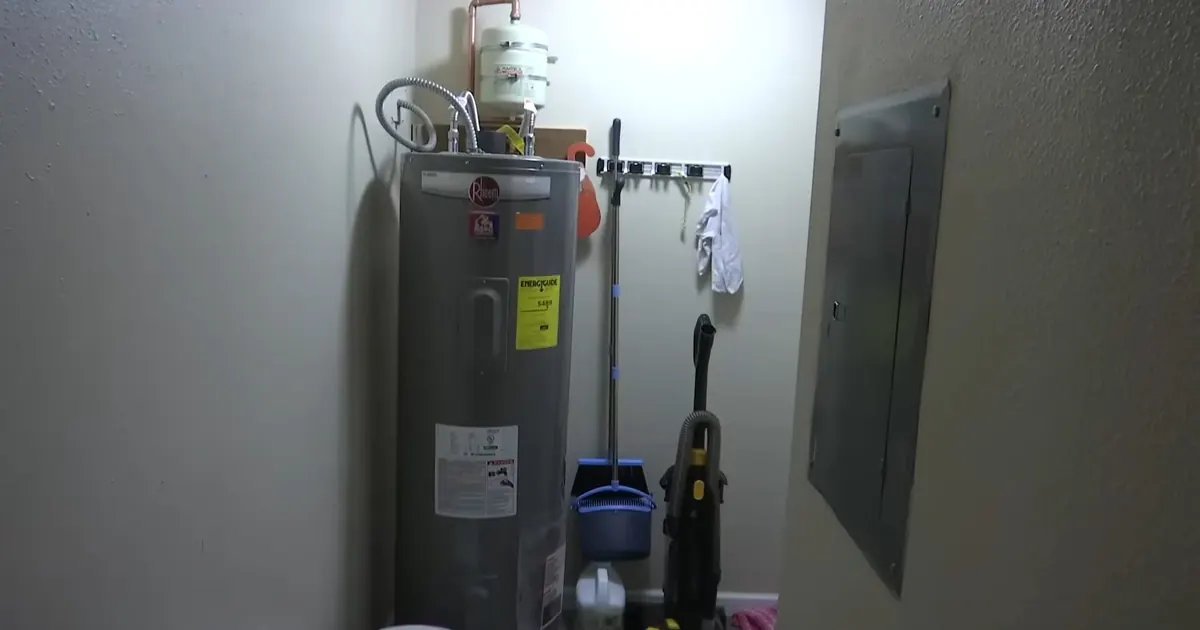
A conventional storage water heater is rated for a service life of 10 to 13 years under soft-water conditions. In Tolleson's hard-water environment at 16 to 19 grains per gallon, the realistic expectation without a water softener in place is 6 to 8 years. The difference is not product quality or installation workmanship. It is the water chemistry acting on the unit continuously from the first day it is placed in service.
How Scale Damages Tank Water Heaters
As hard water heats inside a storage tank, the thermal change causes dissolved calcium and magnesium to precipitate out of solution and deposit as scale on the surfaces they contact. In electric water heaters, this happens primarily at the heating element. In gas units, scale accumulates on the tank walls and the burner chamber floor.
The scale layer insulates the heating element or burner surface from the water it is trying to heat. The unit has to work harder and run longer to reach the target temperature, increasing energy consumption and heat stress on the element or burner. The popping and rumbling sounds common in Tolleson water heaters are the scale deposits cracking and shifting under thermal stress. A water heater making these sounds consistently is accumulating scale at a rate that will significantly shorten its service life.
How Scale Damages Tankless Heat Exchangers
Tankless water heaters avoid the storage tank and its associated scale accumulation on tank walls and sediment on the floor. But they introduce a more compressed version of the same problem: the heat exchanger.
A tankless unit's heat exchanger is a compact coil of pipe with a very large surface area for its volume, designed to transfer heat to water efficiently as it flows through. That large surface area is also an ideal substrate for scale accumulation. In Tolleson's hard-water conditions, a tankless unit without a water softener upstream will typically show flow reduction at the hot outlet within 2 to 3 years as scale accumulates in the heat exchanger passages.
The practical consequence is that a tankless water heater in Tolleson requires a water softener, or at minimum an in-line scale inhibitor, to function reliably over its expected service life. A tankless unit installed without water treatment in Tolleson's water conditions requires significantly more maintenance than the same unit in a soft-water market, and the heat exchanger may need descaling or replacement before the unit reaches half of its rated life.
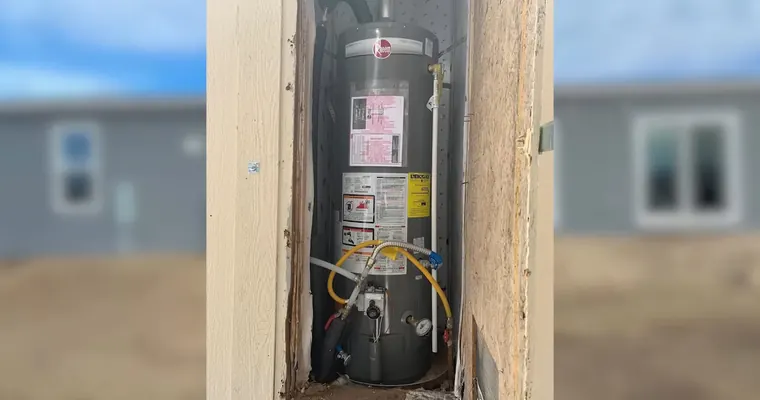
The visible supply, vent, and gas connections are checked during water heater service. It fits the Why Tolleson Water Heaters Fail Earlier Than the Box Says... section. The repair area is visible from a closer angle.
Signs That Scale Is Affecting Your Water Heater
- Popping, cracking, or rumbling sounds during heating cycles, caused by scale deposits cracking under thermal stress
- Longer wait times for hot water at fixtures, or hot water that runs out faster than it used to
- Higher gas or electric bills without changes in household usage or utility rates
- Rusty or discolored water from hot taps, indicating tank wall corrosion beneath accumulated scale
- A tank more than 7 years old in Tolleson's hard-water conditions, even without obvious symptoms
Tank vs Tankless in Tolleson: The Softener Factor
Both tank and tankless water heaters can perform well in Tolleson with the right supporting conditions. The determining factor for tankless units is water treatment upstream.
For conventional tank water heaters, annual flushing to remove accumulated sediment and periodic anode rod inspection can extend service life. The realistic best-case service life for a tank in Tolleson's water conditions with good maintenance is 10 to 12 years. Without maintenance, 6 to 8 years is the typical outcome.
For tankless water heaters, a water softener upstream is the prerequisite for achieving the unit's rated service life of 15 to 20 years. Without water treatment, the heat exchanger maintenance cost and frequency makes the financial case for tankless significantly weaker in this market. A tankless unit with a properly sized softener upstream is a strong long-term investment for a Tolleson home. Without treatment, the expected performance advantage largely disappears.
Repair vs Replace: The Tolleson Water Heater Decision
In Tolleson's water conditions, the repair vs replacement decision depends primarily on the unit's age. A tank unit 7 years old or older that needs a significant repair (heating element, gas valve, or thermostat) is typically better replaced than repaired: the repair cost is substantial relative to the remaining service life the unit is likely to provide. A tank less than 4 years old with a failed component may be worth repairing, since it still has reasonable expected life remaining. For units in the 4-to-7-year range, the decision depends on the repair cost, the unit's overall condition, and whether water treatment is in place.
Further Reading
Our Water Heater Repair and Replacement page covers the repair vs replacement decision in detail for tank and tankless units, including what conditions we evaluate during a service call and what to expect from a new installation's lifespan in Tolleson's hard-water environment. Our Water Softener Installation page covers pairing a new water heater installation with a softener, which is the most effective approach to maximizing service life for tankless units in this market.