When a Tolleson home's galvanized supply lines reach end of service life, the natural question is what to replace them with. Copper and PEX-A are the two primary residential repipe materials in current use. Both are substantial improvements over aging galvanized steel, but in Tolleson's hard-water environment at 16 to 19 grains per gallon and under Arizona's extreme summer heat cycling, the two materials perform differently in ways that matter for the long-term cost of ownership.
What Copper Does Well
Copper has been the standard residential supply pipe material for most of the 20th century for good reasons. It is durable, resistant to UV and outdoor exposure, and its mechanical properties are well understood. In soft-water markets with stable soils and moderate climates, copper repipes can last 50 years or more with minimal maintenance. Many Original Tolleson homes from the 1950s that were repiped in copper as an upgrade from galvanized have copper lines that are still functional today.
Where Copper Struggles in Tolleson's Conditions
Copper's limitations become more significant in Tolleson's specific environment. Hard water at 16 to 19 grains per gallon corrodes copper from the inside through pitting corrosion. The minerals in hard water, particularly when combined with chloramines from municipal disinfection, accelerate the reaction between the water chemistry and the copper pipe wall. Over time, small pits develop on the interior surface and gradually deepen. In soft-water markets, copper shows minimal pitting after 30 or 40 years. In Tolleson's hard-water conditions, meaningful pitting can develop in 15 to 25 years in susceptible configurations.
The second challenge is thermal cycling. Arizona attics regularly reach 150 degrees Fahrenheit or higher during summer months. Supply lines running through unconditioned attic spaces experience extreme temperature swings between overnight lows and afternoon highs, as well as between the water temperature inside the pipe and the surrounding air temperature. Copper expands and contracts with this cycling, and soldered joints at fittings accumulate mechanical stress with each cycle. Over decades, this can cause joint creep or microcracking at solder connections.
What PEX-A Offers in Tolleson's Conditions
PEX-A, the highest-flexibility grade of cross-linked polyethylene, addresses both of these limitations directly.
PEX-A does not corrode in contact with hard water. The polymer is chemically inert to the mineral chemistry of Tolleson's supply water. Hard water deposits scale on PEX-A's interior, as it does on any surface, but it does not pit or thin the pipe wall the way it does with copper. A PEX-A installation in Tolleson's water conditions is not on the same deterioration timeline that copper follows in this environment.
PEX-A's flexibility also makes it better suited to Arizona's thermal cycling. The material expands when hot and returns to its original dimensions when cool, without accumulating stress at connection points. The expansion-style fittings used with PEX-A press into the pipe end rather than relying on solder, eliminating the thermal stress failure mode at connections that can develop in soldered copper over decades of cycling.
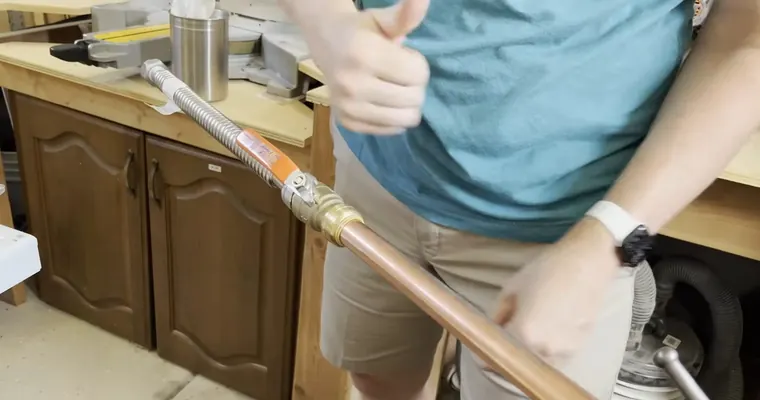
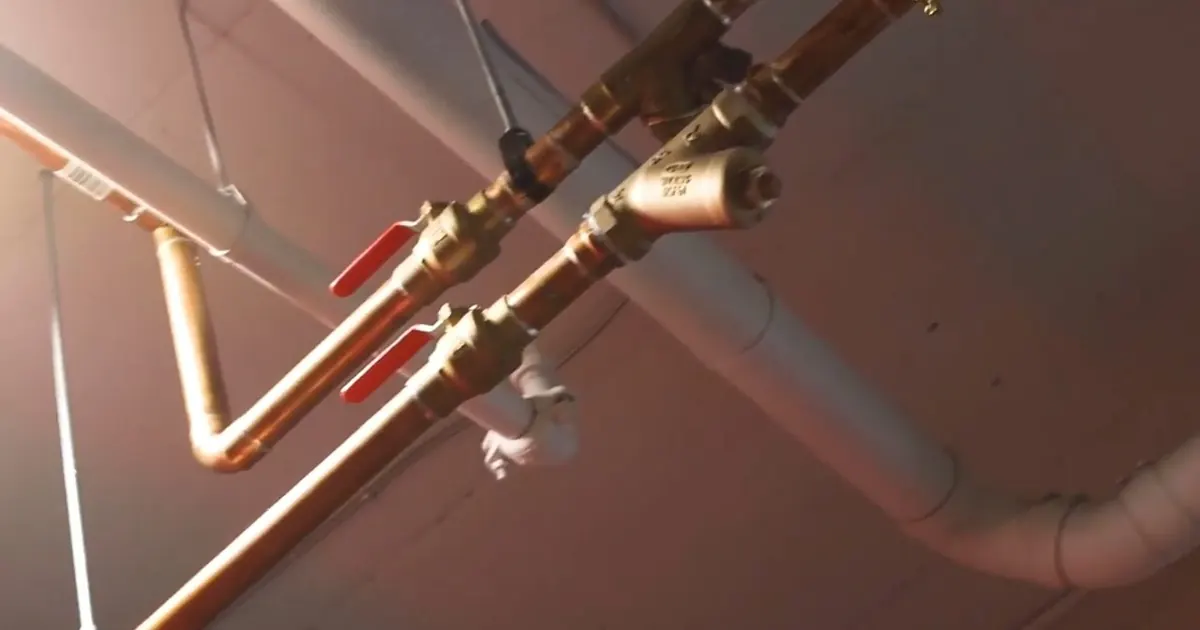
Visible pipe connections help show the repair area clearly before the next step begins. It fits the PEX-A vs Copper Repiping in Tolleson's Hard Water: What the... section. The repair area is visible from a closer angle.
The Expansion Fitting Advantage
The method of joining PEX-A pipe matters as much as the material itself. PEX-A uses expansion fittings: the pipe end is expanded with a specialized tool, a fitting is inserted, and the pipe's shape memory causes it to contract tightly around the fitting as it returns to its normal diameter. This creates a mechanically sound connection that is not dependent on solder, adhesive, or crimp rings. In Arizona's thermal cycling environment at a high-pressure residential water service, expansion fittings have a documented reliability record that makes them the appropriate choice for repipe work in this region.
Manifold Distribution
Most PEX-A repipes in Tolleson use a manifold distribution system: a central connection point near the water heater from which individual dedicated lines run to each fixture and appliance. This differs from the branching tree configuration in older galvanized and copper systems, where a single main line supplies multiple fixtures in series. The manifold approach delivers consistent pressure at every fixture regardless of how many others are in use simultaneously, allows any fixture to be isolated at the manifold for maintenance without affecting the rest of the house, and simplifies future service work on any individual line.
The Long-Term Cost Perspective
For a Tolleson homeowner choosing between copper and PEX-A for a repipe, the relevant comparison is not just the day-one material cost. A copper repipe in Tolleson's water conditions that requires attention within 15 to 20 years due to pitting or joint failures represents a different long-term cost than a PEX-A system that is not susceptible to hard-water pitting corrosion. For most Original Tolleson homes receiving a repipe after decades of galvanized service, PEX-A is the appropriate choice for the local conditions.
Further Reading
Our Repiping page covers the full scope of a PEX-A whole-home repipe at a Tolleson property, including the manifold distribution system, the permit and inspection process through City of Tolleson Building Safety, and what the project involves for an occupied home. For homes receiving a new repipe, our Water Softener Installation page covers pairing the new pipe system with a softener from installation day, which is the most straightforward time to add water treatment to the system.